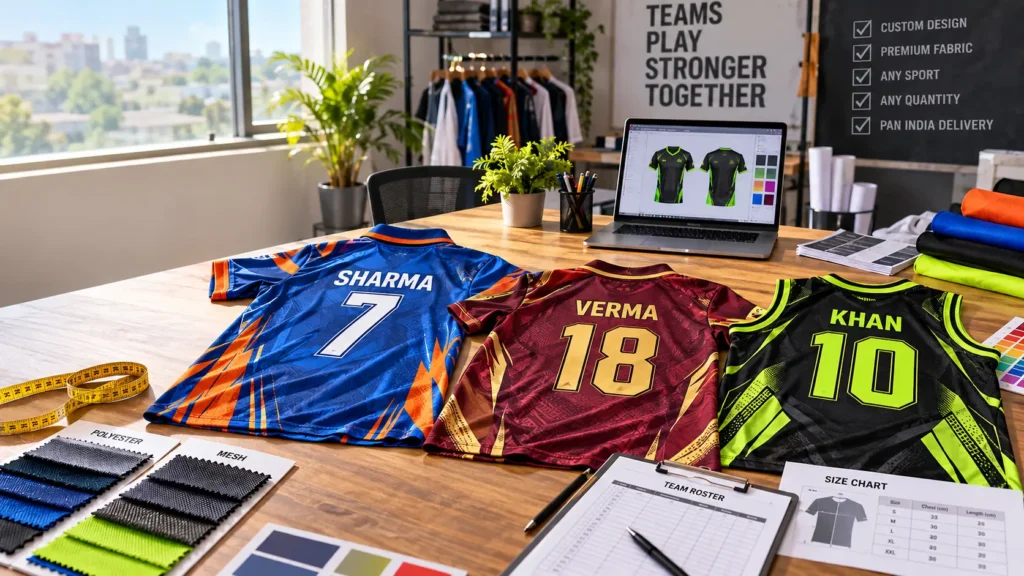
Ordering custom team jerseys looks simple until you’re three days from a tournament. By then someone’s name is misspelt, two players have the same number, and the XL jerseys fit like XXL.
The jersey itself is rarely the problem. The ordering process is.
This guide walks you through that process the way experienced team managers handle it. You’ll work backwards from your match date, collect sizes properly, choose fabric for Indian conditions, and approve a design without missing anything. It works whether you’re kitting out a cricket XI, a school football team, an academy or an entire tournament.
Key takeaways
- Start 5–6 weeks before your event, not 1–2.
- Order for your full squad plus spares, not just the playing XI.
- For most team sports in Indian conditions, sublimated polyester is the practical default.
- Your roster spreadsheet (name, number, size) is your order. Get it right before you ask for a quote.
- Check the mockup against a written checklist before approving it.
What Are Custom Team Jerseys?
Custom team jerseys are sports jerseys made to a team’s own design, colours, logos, player names and numbers, usually produced in bulk for the whole squad. Unlike ready-made jerseys bought off a shelf, they’re manufactured after the design is approved. That’s why every player gets the same look, with their own name and number.
They’re used by cricket and football teams, schools, colleges, academies, clubs, corporate leagues and tournament organisers. Explore our custom team jerseys →
Quick Answer: How to Order Custom Team Jerseys (9 Steps)
- Fix your match or event date and plan backwards.
- Count your full squad, including substitutes and spares.
- Choose a fabric suited to your sport and weather.
- Choose a printing method (sublimation for most teams).
- Prepare a clear design brief with logos and colours.
- Build a roster sheet with names, numbers and sizes.
- Confirm sizing using the manufacturer’s size chart.
- Review the mockup against a checklist, then approve.
- Check every piece when the order arrives.
Each step is explained below.
Step 1: Fix Your Deadline and Work Backwards
The most common reason team orders go wrong is lack of time. When there’s no buffer, nobody double-checks the roster, the mockup gets approved on a phone screen at midnight, and any error becomes permanent.
A safe planning timeline looks like this:
| Time before event | What should happen |
|---|---|
| 5–6 weeks | Fix budget, shortlist manufacturers, start collecting player details |
| 4 weeks | Share design brief, receive first mockup, request changes |
| 3 weeks | Approve final design and final roster; production starts |
| 1–2 weeks | Production, packing and dispatch |
| Final week | Buffer for delivery delays or corrections |
Many manufacturers can move faster than this. The buffer isn’t there because production is slow. It’s there because it gives you room to fix a mistake before match day.
Step 2: Decide How Many Jerseys You Actually Need
Order for your squad, not just your playing team. Substitutes, a 12th man, reserve players and late additions all need kits.
| Sport | Players on field | What to plan for |
|---|---|---|
| Cricket | 11 | The playing XI plus reserves; many squads carry a few extra players |
| Football | 11 | Outfield players plus substitutes; the goalkeeper needs a different-coloured kit |
| Basketball | 5 | Full roster (FIBA-style rosters allow up to 12 players) |
| Volleyball | 6 | Include substitutes; the libero wears a contrasting jersey |
| Kabaddi | 7 | Players on the mat plus substitutes |
What does MOQ mean for your team?
MOQ (Minimum Order Quantity) is the smallest number of pieces a manufacturer will produce in one order. At All Play Sports, the MOQ is 11 pieces, which is exactly one playing XI in cricket or football. Most teams comfortably cross this once they count substitutes.
Two practical tips:
- Order 1–2 spares without names. When a new player joins mid-season, you won’t need to reorder a single piece.
- Ask how a goalkeeper or libero kit is counted in your order, since it’s usually a different colour.
Step 3: Choose the Right Fabric for Indian Conditions
India’s heat and humidity make fabric the single biggest comfort factor. Cotton is a poor choice for match jerseys. It absorbs sweat, gets heavy, clings to the body and dries slowly.
| Fabric type | What it’s good for | Things to know |
|---|---|---|
| Polyester / dry-fit | Most team sports; everyday matches | Light, quick-drying, works with sublimation |
| Micro-polyester | Match kits needing a smoother, finer feel | Good print sharpness |
| Mesh / airtex-style knits | Hot, humid conditions; underarm and side panels | More breathable; slightly more see-through in light colours |
| Lycra / spandex blends | Cycling, running, fitted kits | Stretchy; not always needed for cricket or football |
| Cotton | Casual team tees, fan wear | Not suitable for sublimation or intense play |
What is GSM? GSM (grams per square metre) measures fabric weight. A lighter GSM feels cooler. A heavier GSM usually feels sturdier and more durable. Ask your manufacturer which GSM they recommend for your sport and how often you’ll play, rather than chasing a number.
Step 4: Understand Printing Methods
Why sublimation is the default for team jerseys
Sublimation printing uses heat to turn special ink into gas, which bonds with polyester fibres, so the design becomes part of the fabric instead of sitting on top of it. Because nothing is layered on the surface, sublimated designs don’t crack or peel the way some printed layers can. They also allow unlimited colours, gradients and all-over patterns at no extra cost per colour.
| Method | Best for | Limitations |
|---|---|---|
| Sublimation | Full-colour, all-over team jersey designs | Needs polyester and a white or light base fabric |
| Screen printing | Simple designs with few colours on large quantities | Each colour adds setup; less suited to per-player names |
| Heat transfer / vinyl | Names and numbers on plain jerseys | Can peel or crack over time if poorly applied |
| DTF (direct-to-film) | Detailed logos on cotton or blends | Adds a printed layer on top of the fabric |
| Embroidery | Crests and logos on polos, jackets, formal kit | Heavier; not ideal for large areas on match jerseys |
When sublimation isn’t the right choice
Sublimation doesn’t work on cotton, and it can’t produce a truly black or dark-coloured base fabric underneath the design. Dark jerseys are achieved by printing the dark colour onto light fabric. For cotton fan tees or embroidered polos, another method is better.
Looking for custom team jerseys? All Play Sports makes custom sublimated jerseys for cricket, football and other team sports, designed to your colours and requirements. Request a quote →
Step 5: Prepare Your Design Brief
A clear brief means fewer revision rounds and a faster mockup. Share:
- Team name exactly as it should appear
- Team colours, ideally as Pantone or HEX codes (or a reference photo of existing kit)
- Logo files, in vector format (AI, EPS, SVG or PDF) where possible
- Sponsor logos and where each should go (chest, sleeve, back)
- Collar and sleeve style: round neck, polo collar, V-neck, half sleeve, full sleeve
- Reference designs you like (a screenshot is fine)
- Additional items: shorts, trousers, caps, training tees — see our sportswear products
Logos and file formats
A logo pulled from WhatsApp or a social media profile photo is usually low-resolution and will print blurry. If you don’t have a vector file, ask whoever designed the logo. Or tell your manufacturer up front, because they may be able to redraw it.
Colours: screen vs fabric
Colours on your phone or laptop screen won’t match printed fabric exactly, because screens produce colour with light. If a specific shade matters (a school’s official maroon, for example), share a physical sample or a Pantone code.
Sponsor logos and league rules
Some leagues and school tournaments restrict sponsor logo sizes or positions, or specify rules on numbers. Check with your organiser before the design is finalised, not after.
Step 6: Build a Clean Roster (Names, Numbers & Sizes)
For a team order, your roster spreadsheet is the most important document you’ll send. Every row becomes one jersey, and a spelling mistake in the sheet becomes a spelling mistake on the jersey.
Use separate columns. Don’t combine information in one cell:
| # | Player full name | Name to print | Number | Size | Sleeve | Notes |
|---|---|---|---|---|---|---|
| 1 | Rahul Sharma | SHARMA | 7 | L | Half | Captain |
| 2 | Aditya Verma | ADI | 18 | M | Full | — |
| 3 | (Spare) | — | — | XL | Half | No name |
Roster checklist:
- Agree on a name format first: surname only, first name, or nickname.
- Fix capital letters and spelling before sending.
- Check for duplicate numbers.
- Set a character limit for long names so they fit across the back.
- Have one person (not the whole WhatsApp group) own the final sheet.
Step 7: Get the Sizing Right
Sizes vary between manufacturers. One brand’s “M” may fit like another brand’s “L”. Never assume.
The simplest reliable method:
- Get the manufacturer’s size chart, which usually shows chest width and length.
- Ask each player to lay a jersey that fits them well flat on a table.
- Measure it armpit to armpit (then double it for chest) and collar to hem (length).
- Match those measurements to the chart.
Also plan for:
- Kids’ sizes for school and academy teams. Numbers may need to be smaller to fit youth jerseys.
- Women’s fits for women’s and mixed teams. A men’s cut on women players often fits poorly.
- Plus sizes. Confirm availability early.
- Fit preference. Some players prefer a relaxed fit, others a closer fit. Decide as a team.
Step 8: Review the Mockup Like a Checklist
A mockup is a digital preview of your jersey before production. Once you approve it, the manufacturer will produce exactly what you approved. Review it on a laptop screen, not just a phone.
Mockup approval checklist:
- ☐ Team name spelt correctly
- ☐ Colours match your brief
- ☐ Logo is sharp and correctly placed
- ☐ Sponsor logos are in the right positions and sizes
- ☐ Collar and sleeve style are correct
- ☐ Name and number font is readable from a distance
- ☐ Back numbers are large enough to be seen by umpires, referees or scorers
- ☐ Front, back and both sleeves have been shown
- ☐ Goalkeeper or alternate kits are included, if needed
- ☐ The roster attached to the approval is the final version
Get approval from whoever is responsible for the budget (coach, principal, club secretary) before you confirm. That way nobody requests changes after production has started.
Step 9: Production, Delivery and What to Check When the Box Arrives
After approval, the jerseys go through printing, cutting, stitching, quality checks and packing. Get tracking details once the order is dispatched.
When the order arrives, before distributing:
- Count the pieces against your roster.
- Check every name and number against the sheet.
- Check sizes by pulling out one jersey from each size.
- Inspect stitching at shoulders, underarms and hems.
- Report any issue to the manufacturer immediately, with photos.
Doing this on arrival, rather than on match morning, gives you time to get problems resolved.
What Affects the Price of Custom Team Jerseys?
Prices vary widely across India, so the only accurate figure is a quote based on your exact requirements. The main factors are:
- Quantity. Larger orders usually lower the per-piece cost.
- Fabric type and weight.
- Collar and sleeve style. Polo collars and full sleeves typically cost a little more.
- Level of customisation. A simple design vs a full sublimated design with sponsors.
- Additional items. Shorts, trousers, caps.
- Delivery location and timeline.
When comparing quotes, compare like with like: same fabric, same print method, same inclusions (names, numbers, logos). The cheapest quote often uses a different fabric or excludes personalisation.
Planning a bulk order? Share your team size, sport, colours and deadline, and get your team kit customised according to your design and requirements. Get a quote →
Sport-Specific Notes
Custom cricket jerseys
Cricket involves long hours in the sun, so breathability matters more than almost anything else. Decide early between half and full sleeves (some players prefer full sleeves for sun protection) and whether you need matching trousers. For tournaments with coloured-clothing formats, check whether your organiser specifies colours. Explore custom cricket jerseys →
Custom football jerseys
Football kits usually include jersey and shorts, sometimes socks. The goalkeeper must wear colours that distinguish them from outfield players and the referee, so plan a separate goalkeeper kit. Explore custom football jerseys →
Common Mistakes Teams Make
- Ordering 1–2 weeks before the event, which leaves no margin for errors.
- Ordering only for the playing XI and forgetting substitutes.
- Collecting sizes over WhatsApp without a size chart.
- Sending low-resolution logos from screenshots.
- Approving mockups on a phone without checking every panel.
- Duplicate numbers that nobody noticed.
- Choosing cotton for match jerseys to save money.
- Adding players after approval, which can delay the whole order.
Ordering for a School, Academy or Tournament?
Institutional orders have a few extra considerations:
- Approvals. Get design and budget sign-off in writing from the principal, director or committee.
- Invoicing. If your institution needs a GST invoice, ask for it when requesting your quote.
- Multiple teams. For tournaments or house teams, one base design in different colours keeps production efficient and the look consistent.
- Repeat orders. Ask your manufacturer to keep your design file, so next season’s order for new students is quick.
- Age ranges. Schools often need both kids’ and adult sizes in one order.
Caring for Your Jerseys
- Wash inside out in cold or lukewarm water.
- Avoid bleach and harsh detergents.
- Line dry in shade rather than direct harsh sun.
- Avoid ironing directly on printed names or numbers if they’re heat-applied rather than sublimated.
Final Thoughts
Good team jerseys come from good preparation. Start early, count your full squad, send a clean roster, and check the mockup and delivery properly. Do that, and you’ll avoid almost every problem teams run into.
Ready to order custom team jerseys? All Play Sports manufactures custom jerseys and team kits for cricket, football and other sports, with custom names, numbers and designs, a minimum order of 11 pieces, and worldwide delivery. Contact us →
Frequently Asked Questions
How many jerseys should I order for a cricket team?
Order for your full squad, not just the playing XI. Include reserve players and one or two unnamed spares for new players. All Play Sports’ minimum order is 11 pieces.
What is the minimum order quantity for custom jerseys?
MOQ varies by manufacturer. At All Play Sports, the minimum order is 11 pieces, which is equal to a cricket or football playing XI.
Which fabric is best for team jerseys in hot Indian weather?
Lightweight polyester or dry-fit fabrics, sometimes with mesh panels, are best. They wick sweat and dry quickly. Avoid cotton for match jerseys because it absorbs sweat and stays wet.
What is sublimation printing on jerseys?
Sublimation is a heat-based printing process where ink bonds into polyester fibres, so the design becomes part of the fabric. It allows full-colour designs and doesn’t crack or peel like surface prints can.
Can cotton jerseys be sublimated?
No. Sublimation works on polyester fabrics. For cotton, other methods such as screen printing or DTF are used.
How do I add player names and numbers to team jerseys?
Send a roster spreadsheet with separate columns for the name to print, number and size. Check spellings and duplicate numbers before sending, because names can’t be corrected after printing.
How long does it take to make custom team jerseys?
Timelines depend on the manufacturer, order size and design approval speed. Start planning 5–6 weeks before your event to allow time for mockup revisions, production, delivery and corrections.
How much do custom team jerseys cost in India?
The cost depends on quantity, fabric, collar and sleeve style, customisation level and additional items like shorts. The accurate way to compare is to request quotes with identical specifications.
Can I order different sizes in one team order?
Yes. Team orders are normally made in mixed sizes, with each player’s size listed in the roster.
Can I use my own jersey design?
Yes. You can share your own design, logos and colours, or a reference design, and the manufacturer will prepare a mockup for approval.
Do you deliver custom jerseys worldwide?
Yes. All Play Sports delivers custom sportswear orders across India and worldwide.
What should I check before approving a jersey mockup?
Check spellings, colours, logo placement and sharpness, sponsor positions, collar and sleeve style, number size, and that the final roster is attached.